Treat child-resistant packaging as one layer of secure storage
A difficult cap can feel reassuring, especially when an adult has trouble opening it. Child-resistant packaging still does not mean childproof. Use the package as intended while keeping medicines and hazardous household substances securely inaccessible, including those that enter the nursery inside a visitor’s bag or a temporary supply basket.
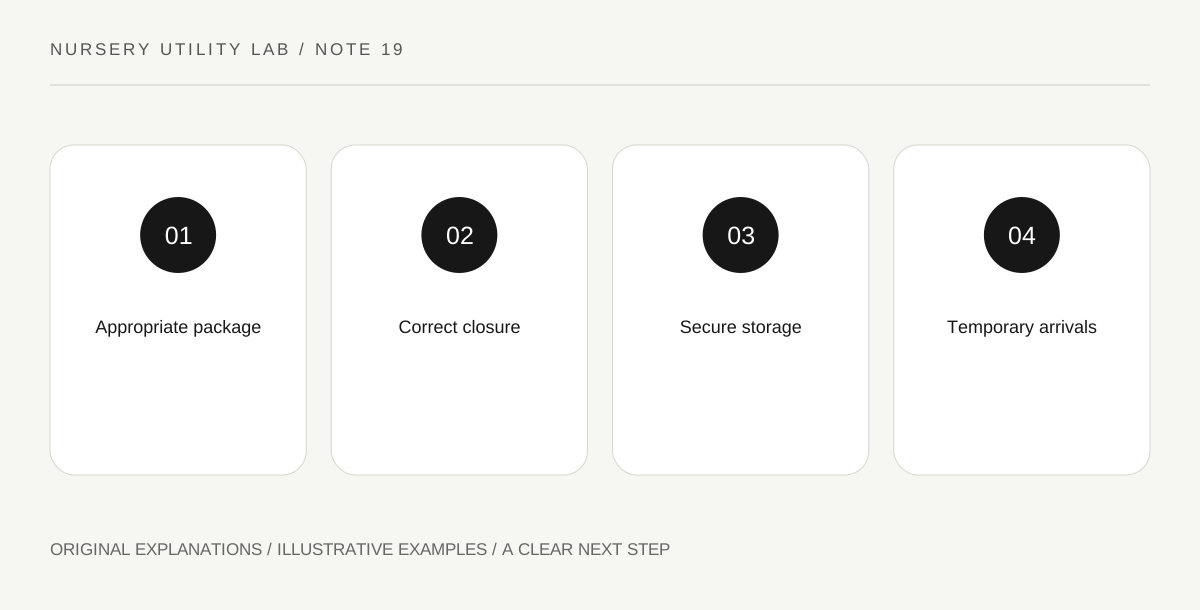
Original explanatory diagram. Read the full method and limitations below.
Understand the claim without inventing a guarantee
CPSC's poison-prevention packaging guidance explains the child-resistant distinction. It describes packaging designed to be difficult for young children to open, not impossible. An adult's own difficulty does not establish what a child can do, and a cap that once resisted opening may not be properly engaged now. Avoid using a child to test it. The practical boundary is secure storage plus correct closure, rather than confidence derived from a difficult opening attempt.
Keep the original product identity
Do not move medicines or hazardous substances into an ordinary food container to make nursery storage more attractive. The original label and appropriate closure carry important information. If a household needs a different accessible arrangement for an adult's disability or other circumstances, discuss appropriate options with a pharmacist or relevant professional while maintaining child protection. A convenient replacement container should not quietly remove the safety and identity features of the product being stored.
Reclose after each adult use
Read the actual closure instructions and ensure adults understand what completed engagement means for that package. A cap loosely resting on top is not the intended closed state. Return the product to secure storage promptly rather than leaving it on the changing station for the next adult. If the closure becomes damaged or unclear, obtain an appropriate replacement or professional direction. Do not rely on a tight elastic band or another homemade addition as an equivalent protective closure.
Include temporary arrivals
A visiting adult's handbag, a grocery delivery or a refill waiting to be put away can introduce a hazardous substance outside the usual locked location. Give adults an appropriate inaccessible destination for such items. A storage plan should survive ordinary movement through the home, not only describe the cabinet after tidying. If exposure may have occurred, seek immediate appropriate emergency or poison-information guidance; do not delay care while experimenting to see whether the child could open the package.
Illustrative worked example
Illustrative visitor arrangement: A relative brings a medicine bottle in a bag and places the bag near the nursery chair. The family provides a secure adult-managed destination and explains that a child-resistant cap does not replace storage. After use, the adult recloses the actual package correctly. The example does not predict whether a child can open a bottle or offer treatment instructions for a possible exposure.
Questions that come up
Does my difficulty opening the cap prove it is childproof?
No. Child-resistant packaging is not childproof. Use it correctly alongside secure storage and appropriate adult attention.
Can I store medicine in a snack box with a warning sticker?
Do not substitute an ordinary food container for the appropriate labeled package. Ask the pharmacist about suitable arrangements when the original setup is difficult to use.
References and scope
These sources support the factual background. Examples and exercises are original illustrative teaching material. References do not imply endorsement.
- CPSC: Poison prevention packaging guide — Child-resistant packaging is not childproof.