Choose window coverings before arranging the crib wall
Window coverings are part of nursery preparation because their cords can create a strangulation hazard. CPSC identifies cordless coverings as the safest option where young children are present. Review the actual window treatment before placing furniture, rather than relying on whether a dangling cord is visible in a room photograph.
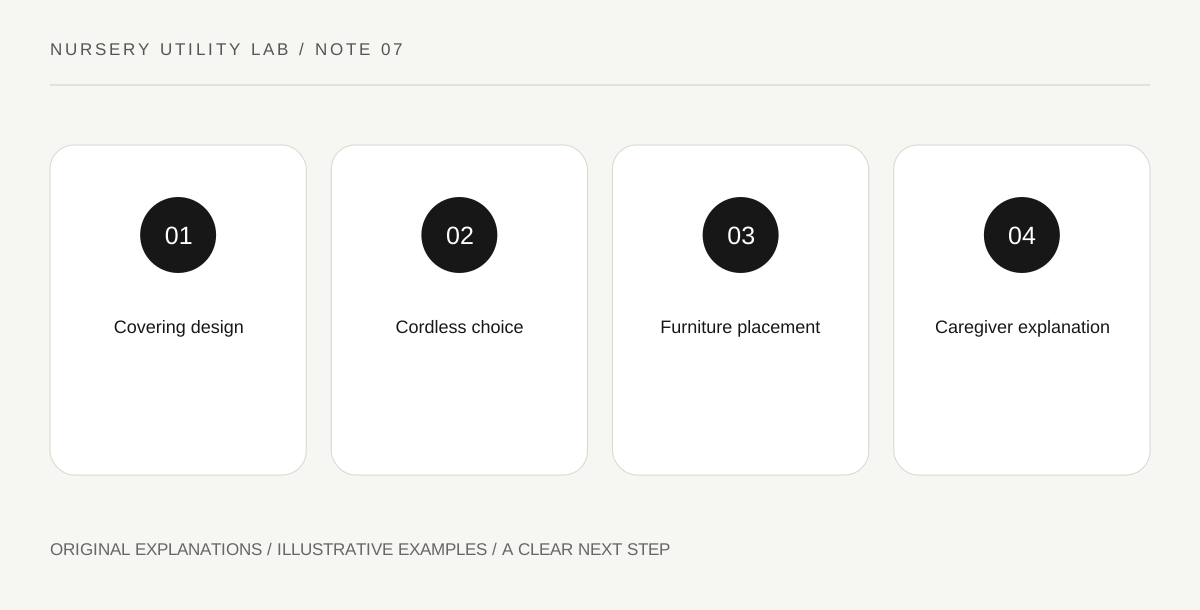
Original explanatory diagram. Read the full method and limitations below.
Inspect every operating position
A covering can look tidy while raised and reveal a different arrangement when lowered. Identify the exact product and how it operates without children nearby. Look beyond the most obvious pull cord to loops and accessible operating components. Ask the supplier about a verified cordless replacement when needed. A marketing image showing a clean window edge does not establish how the installed product works throughout its travel or whether hidden cords remain accessible.
Plan replacement as a product decision
CPSC explains that cordless coverings eliminate the cord-strangulation hazard, while interim measures for corded products only reduce it. This distinction belongs in the shopping and installation plan. Do not call a corded product safe merely because an adult ties its cord up today. Ask a suitable provider to identify a cordless option that fits the window and installation conditions. Keep other product hazards and ordinary window safety as separate questions rather than assuming cordless means every aspect of the window is resolved.
Arrange furniture with access in mind
CPSC advises moving cribs, beds, furniture and toys away from window-covering cords, preferably to another wall. A nursery layout should account for how a child may reach as abilities change. Avoid placing a dresser below a treatment because the cord seems high from the floor. Do not use the baby to check whether something can be reached. The aim is to remove access routes, not establish the greatest distance a particular child can stretch today.
Explain the boundary in a shared-care room
Tell visiting caregivers and relatives why the treatment and furniture arrangement matter. When staying elsewhere, review the actual room rather than assuming a guest nursery follows the home plan. An adult-managed note can record the covering type and any unresolved replacement task. Follow current official guidance for interim measures while arranging replacement, recognizing their limitations. A room should not be declared complete because the window fabric matches the crib bedding or because someone nearby intends to watch closely.
Illustrative worked example
Illustrative layout revision: A family plans to put the dresser below a corded blind. On reviewing CPSC guidance, they change the furniture plan and arrange a suitable cordless replacement. They ask the installer about the actual window rather than ordering from dimensions remembered from another room. The example does not claim that tying a cord higher eliminates the hazard or that room supervision substitutes for removing it.
Questions that come up
Does keeping the cord short eliminate the hazard?
CPSC distinguishes risk-reduction measures from eliminating cord strangulation through cordless coverings. Do not describe an interim measure as equivalent to replacement.
Is a high cord automatically out of reach?
Furniture can create a route to it. Review the whole layout instead of considering only the height above the floor.
References and scope
These sources support the factual background. Examples and exercises are original illustrative teaching material. References do not imply endorsement.
- CPSC: Window-covering cords — Cordless coverings eliminate the cord-strangulation hazard; furniture access matters.