Review toy storage as furniture with a lid
Toy storage is often selected for capacity or how neatly it hides a play area. A chest or trunk also has a lid, hinges, an interior and sometimes a latch. CPSC warns about serious entrapment and suffocation hazards in storage and toy chests, so evaluate those features before bringing one into a child’s environment.
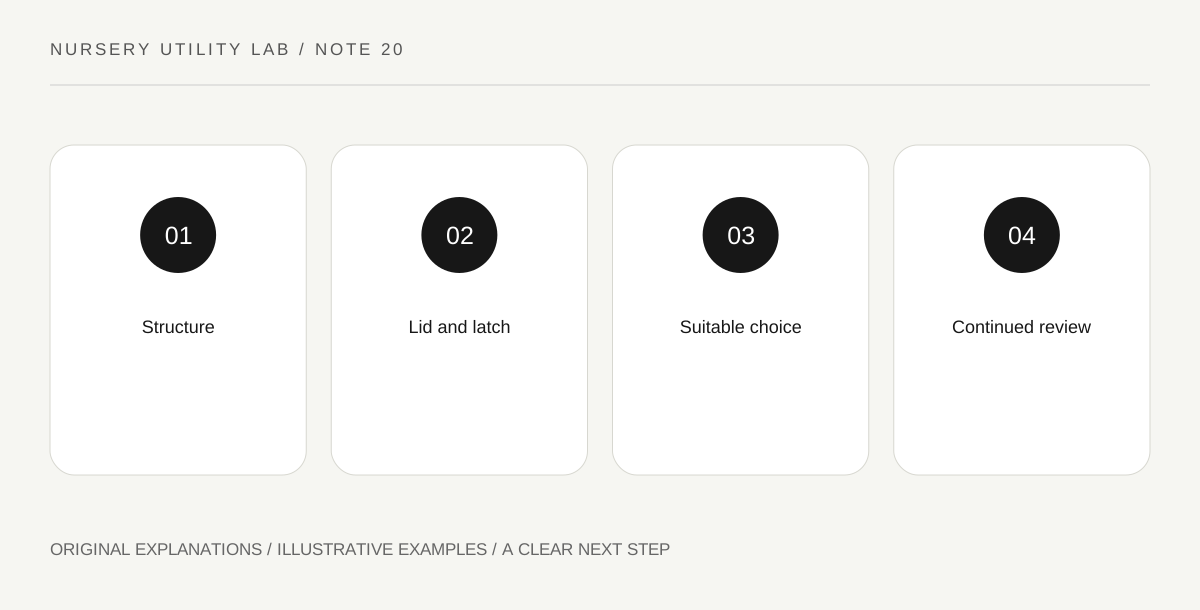
Original explanatory diagram. Read the full method and limitations below.
Identify more than the container's name
A decorative trunk, cedar chest or adult storage box can end up holding toys without becoming a suitable toy chest. Read the actual product's instructions and intended use. Consider whether a child could climb inside or reach under a moving lid. The item should be reviewed as a structure, not simply as an attractive box. A product marketed for a hallway or bedroom is not automatically appropriate for a baby's developing play area.
Take the lid and latch seriously
CPSC describes hazards from lids that fall and from chests that automatically latch closed. Do not assume that a lid staying open once means the support remains suitable over repeated use. Inspect and maintain any intended support according to the actual instructions. A missing or damaged component requires a suitable response, not a household prop left under the lid. Keep children away from an unresolved chest rather than making the next retrieval of a toy a trial of its condition.
Prefer a clear accessible storage task
A suitable storage choice should allow adults to manage toys without creating an unnecessary enclosed hiding place or heavy moving lid. Consider an appropriate alternative design on its own merits and instructions. Do not improvise ventilation holes or disable a latch and then declare the original chest safe. Some official warnings include specific removal or repair actions; use the action appropriate to the actual product rather than borrowing a fix from a different model or older internet discussion.
Reassess as the room changes
A chest used only by adults today can become accessible as the child moves and climbs. Keep unsuitable furniture out of the child's environment and include storage in room reviews after rearrangement. Tell other caregivers that the chest is not a seat, hiding place or sleep space. If the item is damaged or recalled, follow the relevant instructions rather than donating the unresolved hazard as an ordinary toy box. Capacity and matching decor do not compensate for an unsuitable structure.
Illustrative worked example
Illustrative storage choice: A family considers using an old automatically latching trunk for toys. After reviewing CPSC's warning, they keep it out of the child-accessible area and choose an appropriate alternative storage arrangement independently. They do not drill holes and call the trunk converted. The fictional example does not certify another container or claim that supervision eliminates the hazards of a falling lid.
Questions that come up
Does filling a trunk with toys prevent a child entering it?
Do not rely on contents as a protective measure. Review the actual structure and keep unsuitable storage inaccessible.
Can I hold the lid while the child retrieves toys?
Adult presence does not establish that an unsuitable chest has become appropriate. Resolve the actual lid, support and entrapment questions using relevant instructions.
References and scope
These sources support the factual background. Examples and exercises are original illustrative teaching material. References do not imply endorsement.
- CPSC: Storage and toy chests — Storage-chest lid, latch and entrapment hazards.