Recognize a seated wheeled walker before accepting a gift
The word walker can describe several different products, but a seated baby walker with wheels is a particular concern. AAP advises against these devices. Identify the actual design before accepting a gift, and keep a walking-development promise separate from the practical question of what the product lets a baby reach.
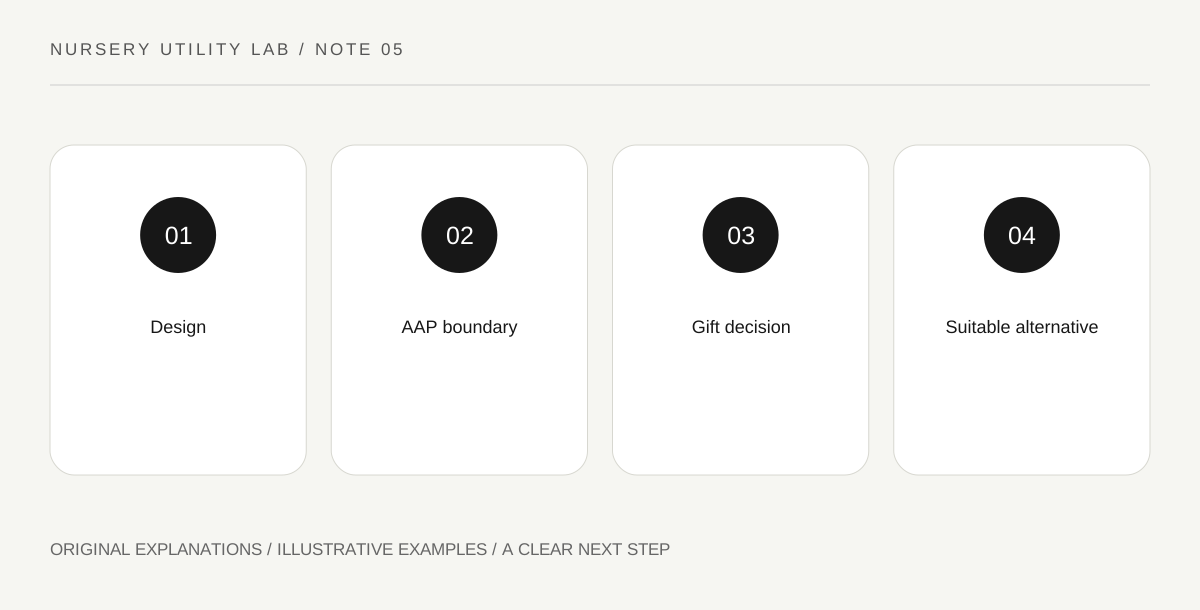
Original explanatory diagram. Read the full method and limitations below.
Identify the seat-and-wheels combination
Look at how the child would be supported and whether the frame rolls as the baby moves. A listing can use activity center, entertainer or walker in overlapping ways. Ask for the actual model and instructions rather than deciding from the seller’s nickname. A stationary product and a seated wheeled walker should not be treated as the same item merely because both have a toy tray or similar fabric seat.
Understand why nearby watching is insufficient
AAP explains that wheeled walkers allow rapid movement and access to hazards, including stairs and hot objects. Being in the room does not make these devices safe. Do not set up a trial with an adult ready to catch the baby or assume one closed stair gate solves the entire problem. The concern includes the new reach and movement the product creates throughout the area, not just whether the floor looks level.
Remove the development promise from the comparison
AAP states that these walkers do not help babies learn to walk. An advertisement suggesting accelerated development should not outweigh the recommendation to avoid the device. Ask the pediatrician about individual development questions rather than treating a purchase as a milestone intervention. Simple suitable play opportunities do not need an advanced label. A product can be entertaining without being a necessary step in the child’s development, and entertainment claims still need to respect safety boundaries.
Choose any alternative on its own instructions
AAP discusses stationary activity centers and other alternatives, but that does not approve every model or every use. Check the actual alternative’s child requirements, limits and instructions. Keep it separate from sleep equipment and maintain appropriate supervision. Do not convert a wheeled walker into a supposedly stationary device by removing wheels or blocking them with household objects. An improvised change does not establish that the remaining structure has become a suitable different product.
Illustrative worked example
Illustrative gift conversation: A relative offers a seated walker on wheels and says it will help the baby practise walking. The caregivers explain that they follow AAP advice against that product category. They discuss a suitable alternative independently rather than trying to disable the wheels. The example does not predict development or endorse a particular activity center; it gives the family a clear product boundary.
Questions that come up
Does a stair-free room make a seated wheeled walker safe?
AAP advises against these walkers even with an adult nearby. Their hazards include access and movement beyond stair falls.
Can I remove the wheels to create an activity center?
Do not improvise a conversion. A different intended product needs its own verified design and instructions, not a household modification.
References and scope
These sources support the factual background. Examples and exercises are original illustrative teaching material. References do not imply endorsement.
- AAP: Baby walkers — Avoid seated baby walkers with wheels; distinguish stationary alternatives.