Keep baby-clothing care instructions through the first laundry cycle
A drawer of small garments can contain very different fabrics, closures and care requirements. Plan the first wash from the actual care labels rather than from the baby-clothing category alone. A simple sorting method should preserve instructions and identify what is ready without turning every gift into an emergency laundry experiment.
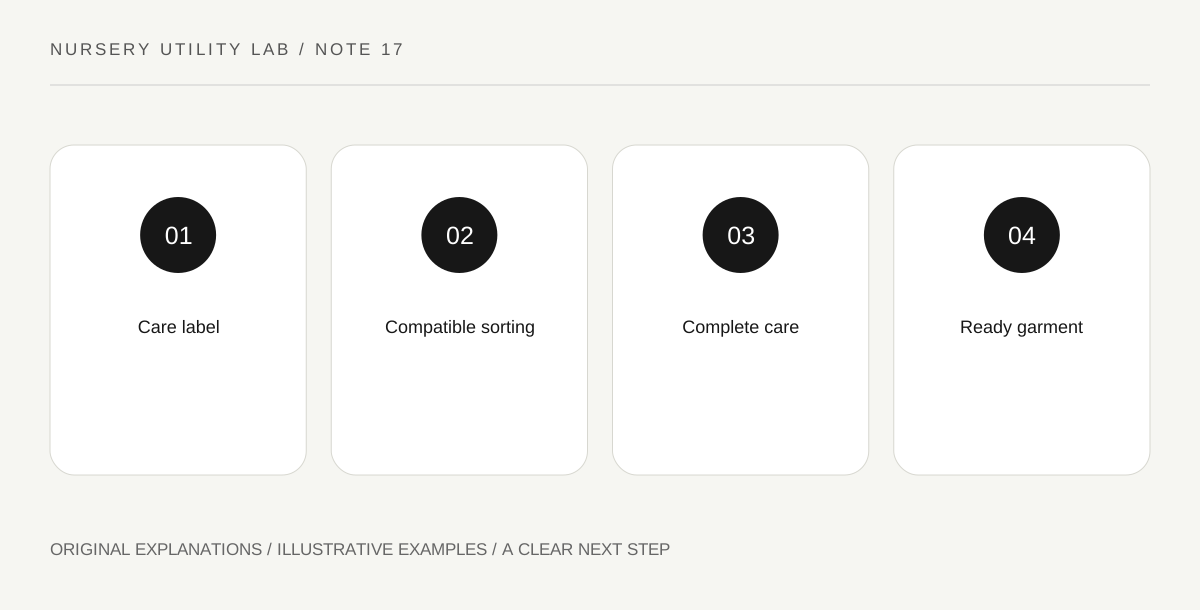
Original explanatory diagram. Read the full method and limitations below.
Read the whole care sequence
A washing permission does not automatically answer drying, bleaching or ironing. FTC's care-labeling rule describes these as parts of regular garment care and includes relevant warnings. Read each actual garment label before grouping items. Two cotton-looking outfits can differ because of trim, elastic or construction. The useful question is how the complete garment can be cared for, not whether one visible fiber seems durable enough for the household's usual hottest cycle.
Sort by compatible care rather than size
Clothing labeled for the same age can need different processes. Group items only where their actual instructions allow a compatible method. Keep an unfamiliar garment separate while resolving a symbol or missing instruction. Do not silently treat a gift's decorative packaging as the care label. If another adult will do the laundry, make the distinction easy to understand using adult-managed notes rather than attaching loose tags or improvised ties that could remain on the baby later.
Preserve fit and closure checks after washing
Once items are cared for and appropriately dry, review their condition before placing them in the ready drawer. Look at closures, seams and any loose trim. Follow product instructions and remove damaged or unsuitable garments from use rather than repairing an uncertain component with a household object. Washing a garment successfully does not establish that its current size, neck opening or use is suitable for the child. Care and fit remain separate questions.
Plan replacements around real use
A small ready supply of suitable, cared-for garments can be more useful than a full drawer of items with unresolved instructions. Notice which closures adults can operate comfortably during changing, without claiming a medical or developmental benefit from one design. Keep outgrown or unsuitable clothing away from the ready set. When a product's care method is impractical for the household, that is a reasonable purchase consideration. Choosing a simpler suitable garment can reduce friction without inventing a universal rule that every baby item needs special treatment.
Illustrative worked example
Illustrative first wash: A family receives several outfits marked for the same age. One has a different drying instruction and is separated from the compatible group. After care, the adults check condition and suitable fit before adding items to the ready drawer. The example does not prescribe a detergent for sensitive skin or assume a fabric label proves medical suitability; it shows how to preserve the actual care information.
Questions that come up
Does machine washable mean any drying process is allowed?
No. Read the drying instruction and warnings separately. A washing permission does not establish every later care step.
Must every baby garment use the same special cycle?
Use the actual garment instructions and appropriate individual guidance. The baby-clothing category alone does not establish one universal care method.
References and scope
These sources support the factual background. Examples and exercises are original illustrative teaching material. References do not imply endorsement.
- FTC: Apparel care labeling — Garment care instructions, drying and warnings.