Keep an oral dosing device with the medicine it belongs to
Liquid medicine and its measuring device form a specific pair. A drawer of unrelated cups and syringes can make a stressful care task harder to understand. FDA advises using the correct dosing device and seeking clarification instead of guessing from mismatched units or substituting a kitchen spoon.
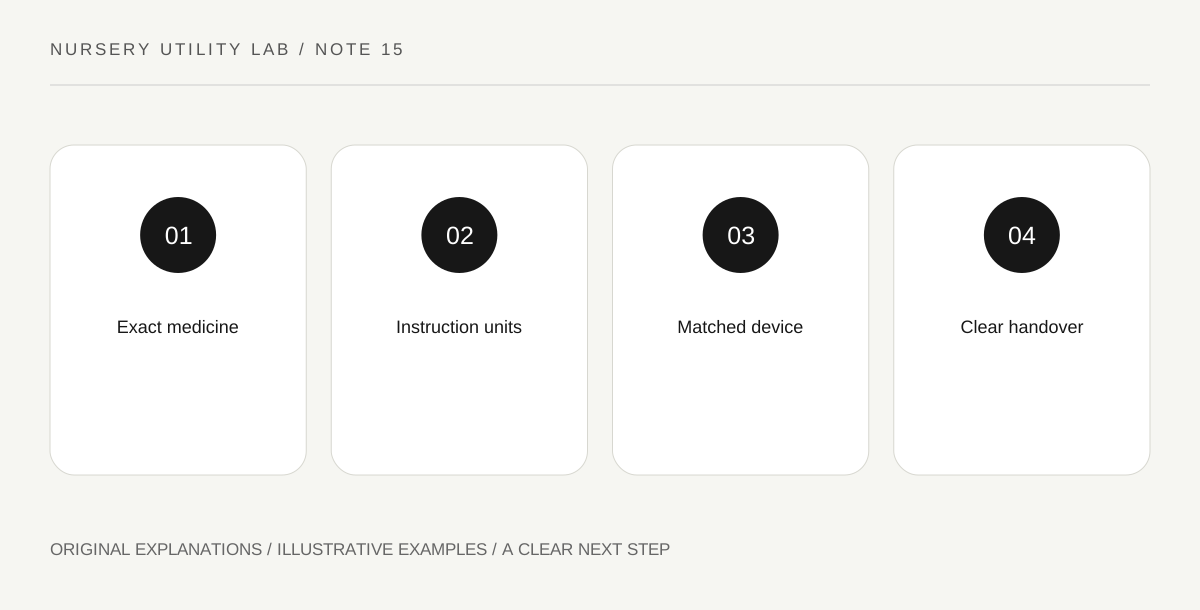
Original explanatory diagram. Read the full method and limitations below.
Begin with the prescribed or labeled instruction
For a baby, obtain appropriate professional guidance about whether a medicine should be used at all. This article does not choose a medicine or dose. Once the clinician or pharmacist has established the relevant instructions, identify the exact product, concentration and intended measuring device. A familiar product name can appear on different formulations. Do not use a remembered amount from an older child or assume a previous bottle establishes instructions for the current one.
Read units on both sides of the task
The amount instruction and the device markings need to correspond. Milliliters describe volume, while milligrams describe a quantity of medicine; they are not interchangeable numbers. If the instruction and tool do not match clearly, ask the pharmacist before administration. Do not estimate between unfamiliar markings or use the size of a household spoon as a conversion. A printed number becomes meaningful only with its unit and the actual product it describes.
Keep the correct tool identifiable
Store the appropriate dosing device with its associated medicine in secure adult-managed storage, following care directions. Avoid dropping unmarked tools into a shared baby-supply basket. If a device is lost, damaged or its markings become unreadable, obtain an appropriate replacement through the pharmacy rather than borrowing a similar-looking tool without checking. A different syringe can have a different scale, and a cup that came with another product does not automatically preserve the same instructions.
Make the handover explicit
Adults sharing care need the actual professional or label directions and a clear record of what has been given and when, as appropriate. A prepared device left nearby is not a complete message. Resolve uncertainty before another administration instead of guessing whether a previous caregiver has already acted. Follow the clinician or pharmacist for errors, unexpected effects or questions. A storage and labeling routine supports safe communication but cannot determine a dose or replace medical assessment.
Illustrative worked example
Illustrative pharmacy question: A caregiver finds that a supplied instruction uses one unit while the available tool does not show it clearly. They contact the pharmacist and obtain the correct explanation and device before giving the medicine. The associated tool stays with that product afterward. The example supplies no medicine recommendation, concentration conversion, dose or administration schedule for readers to copy.
Questions that come up
Can I use a kitchen teaspoon if the syringe is missing?
FDA advises against substituting household spoons. Ask the pharmacist for an appropriate measuring device and clarification.
Does a larger syringe require the same reading technique?
Do not assume tools are interchangeable. Confirm the correct device and markings for the exact instruction before using it.
References and scope
These sources support the factual background. Examples and exercises are original illustrative teaching material. References do not imply endorsement.
- FDA: Read the medicine label — Use the correct dosing device and seek professional clarification rather than guessing.